BGM vs CGM: Which Glucose Monitor Is Right for You?
You're standing in front of two options.
On one side: a familiar routine. Prick your finger, squeeze, test, get a number. You've done it thousands of times. It's cheap, it works, and your insurance probably covers it.
On the other side: a small wearable sensor you stick on your arm once every two weeks. No finger pricks. It sends glucose readings to your phone every few minutes — day and night. But it costs more, and honestly, it feels a bit like stepping into unknown territory.
BGM or CGM?
If this question has been circling in your mind, you're not alone. Millions of people with diabetes are having the same conversation — with their doctors, with themselves, and increasingly, with their glucose data.
This article gives you the honest, jargon-free comparison so you can decide what makes sense for your life — not just your lab results.
First, Let's Get the Terms Straight

That's the surface difference. But the real difference goes deeper — and it changes how you understand your own body.
The Core Difference: Snapshots vs. a Movie
Think of BGM as a photograph. It shows you exactly what your glucose is at one moment in time. 140 mg/dL before lunch. 180 mg/dL at bedtime. Each reading is a still image — accurate for that instant, but telling you nothing about what happened in between.
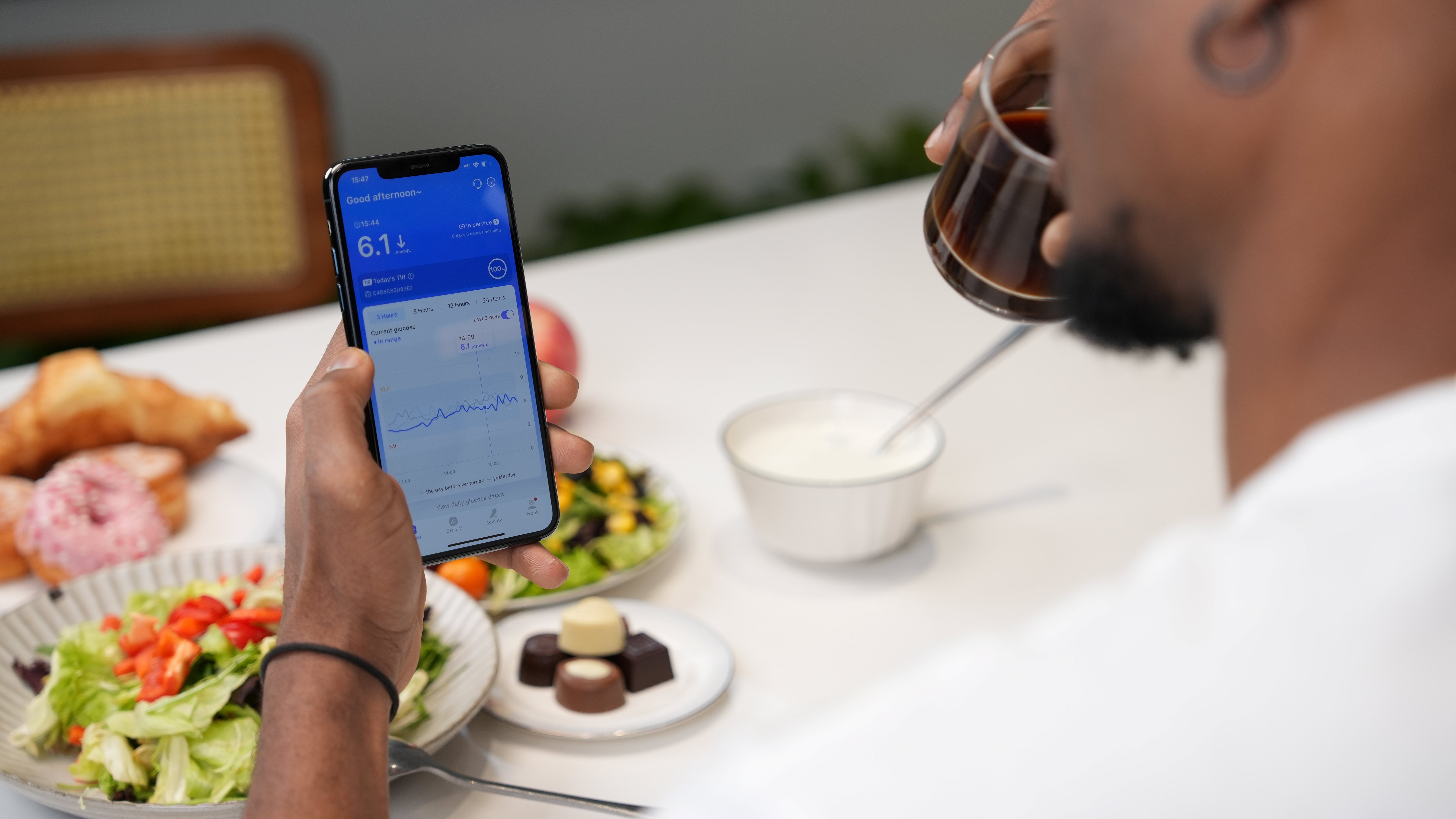
Think of CGM as a movie. It shows you the entire story. Your glucose at 3 AM when you were sleeping. The spike after breakfast. The steady decline during your afternoon walk. The trend arrow that warns you: "You're dropping fast — eat something now."(1)
This is not a minor difference. It's a fundamentally different way of understanding glucose.
Side-by-Side Comparison

What the Research Says: Does CGM Actually Improve Outcomes?
The science is clear — and getting clearer every year.
A 2025 meta-analysis of 11 randomized controlled trials (789 participants) comparing real-time CGM with traditional BGM in type 2 diabetes found that CGM users:(2)
- Lowered HbA1c by an average of 0.20% more than BGM users (p = 0.004)
- Spent 7.4% more time in the healthy glucose range — that's about 1 hour and 47 minutes more per day with glucose between 70–180 mg/dL
- Spent 6.9% less time above range — nearly 2 hours less per day in hyperglycemia
- Had significantly lower glucose variability — fewer and smaller swings
An umbrella review published in 2024 confirmed these benefits across multiple systematic reviews, finding consistent improvements in both type 1 and type 2 diabetes populations.(3)
The real-world implication: CGM doesn't just give you more data. It helps you achieve better glucose control — not by magic, but by making the invisible patterns of your metabolism visible and actionable.
The Hidden Cost of "Only Testing Sometimes"
Here's something most BGM-vs-CGM comparisons miss.
With finger pricks, you see what you test. You test before meals. Maybe after. Maybe at bedtime. That's 4-8 data points per day — if you're diligent. But a 2020 study found that even among motivated patients, actual BGM testing frequency often falls below prescribed levels.(4)
Every untested hour is a blind spot.
You could be going low at 2 AM and never know it. You could spike to 250 mg/dL after a meal you thought was "safe," and the spike resolves before your next scheduled test — so it never appears in your logbook. You're making decisions based on incomplete information.
CGM fills those blind spots automatically. That's not a luxury — for many people, it's the difference between guessing and knowing.
Who Might Be Fine with BGM?
Not everyone needs CGM. Here's when BGM makes sense:
Your glucose is stable and well-controlled
If your HbA1c is consistently in target range, you rarely experience hypoglycemia, and your glucose patterns are predictable — BGM may be sufficient. Testing 2-4 times a day gives you enough information to manage safely.
Cost is your primary constraint
CGM sensors cost more than test strips in most markets. If insurance doesn't cover CGM and the out-of-pocket cost would create financial stress, BGM remains a perfectly valid medical tool. Some monitoring is always better than no monitoring.
You only need occasional checks
If you have prediabetes or well-controlled type 2 diabetes not on insulin, and your doctor recommends periodic rather than continuous monitoring, BGM can meet that need.
Who Should Seriously Consider CGM?
You're on insulin (especially multiple daily injections)
CGM is now recommended as standard of care by major diabetes organizations for people on intensive insulin therapy. The hypoglycemia alerts alone can be life-changing — and potentially life-saving.(5)
You experience hypoglycemia unawareness
If you've stopped feeling the early warning signs of low blood sugar (shakiness, sweating, hunger), you're at risk of severe hypoglycemic events — especially at night. CGM's predictive alerts can warn you before you're in danger.(5)
Your HbA1c isn't where it should be despite your best efforts
If you're doing everything "right" — taking your medication, watching your diet, exercising — but your numbers aren't improving, CGM can reveal the hidden patterns sabotaging your efforts. Maybe it's overnight highs. Maybe it's post-meal spikes. You can't fix what you can't see.
You want to understand how food, exercise, and stress actually affect you
This is where CGM becomes genuinely transformative — not just as a medical tool, but as a personal insight engine. Seeing, in real time, that a 15-minute walk after dinner cuts your glucose spike by 30 points — that's information that changes behavior.
You're caring for a child or elderly parent with diabetes
CGM allows caregivers to monitor glucose remotely through data sharing. For parents of children with type 1 diabetes, this technology has been described as "life-changing" — enabling both better glucose control and normal sleep for the first time in years.(5)
The Middle Ground: What If You Use Both?
This isn't a binary choice. Many people use CGM as their primary monitor and keep a BGM as backup.
Why? Because CGM readings can occasionally diverge from blood glucose — especially during rapid changes. The sensor measures glucose in interstitial fluid (the fluid between your cells), which lags behind blood glucose by about 5-15 minutes. If your CGM reading doesn't match how you feel, a finger-prick check provides confirmation.(1)
CGM manufacturers recommend using a BGM to verify readings when:
- Your symptoms don't match the CGM number
- You're treating a low and want to confirm recovery
- The sensor is in its first or last day of wear (accuracy tends to be slightly lower at the extremes of sensor life)
- You've received a compression low (false low reading from pressure on the sensor — common during sleep)
Bottom line: CGM can replace most finger pricks, but keeping a BGM in the drawer for occasional backup is smart.
Understanding the Accuracy Question
One of the most common concerns: "Is CGM as accurate as finger pricks?"
The short answer: Both are clinically reliable, and modern CGMs are accurate enough for treatment decisions — including insulin dosing — without requiring confirmatory finger pricks.(1)
The slightly longer answer: accuracy is measured by MARD (Mean Absolute Relative Difference) — the average percentage difference between the device reading and a lab-grade blood glucose measurement.
- BGM: MARD typically 5-10%
- Modern CGM: MARD typically 8-10%(6)
For example, the Ottai CGM has demonstrated a MARD of approximately 8.1% in clinical trials — well within the range considered clinically reliable for diabetes management.
The key distinction: BGM measures glucose directly from blood. CGM measures glucose in the fluid surrounding your cells. They're measuring slightly different things — so the numbers won't be identical moment-to-moment. But they trend together, and the trend is what guides decisions.
How to Talk to Your Doctor About Switching
If you're considering CGM, here's a practical framework for the conversation:
What to say:
"I've been reading about continuous glucose monitors and I'm interested in whether one could help me. I'd like to understand my glucose patterns better — especially what happens overnight and after meals. Is CGM appropriate for my situation?"
What to ask:
- "Would CGM be covered by my insurance or national health plan?"
- "Which CGM system would you recommend for my specific needs?"
- "How often should I still check with finger pricks as backup?"
- "What glucose targets should I aim for with CGM metrics like Time in Range?"
- "How do we use my CGM data to adjust my treatment plan?"
What to bring:
- A few days of your BGM logbook (to show current patterns)
- Your most recent HbA1c result
- Specific concerns: "I worry about nighttime lows" or "I can't figure out why my after-breakfast numbers are always high"
The Emotional Side Nobody Talks About
CGM has a learning curve — and it's not just technical.
The first few days can be overwhelming. You go from 4 data points a day to 288. Every meal, every walk, every stressful meeting shows up as a glucose response. It can feel like your body is constantly under a microscope.
The anxiety can spike before it drops. Some people become obsessive about checking their numbers. Others panic when they see a trendy arrow pointing up after a meal they thought was "good."
This is normal. Within a week or two, most people settle into a healthier relationship with the data — using it as information, not judgment. The goal isn't a perfectly flat glucose line. (That's biologically impossible.) The goal is understanding your patterns and making small, sustainable adjustments.
Final Verdict: Which Should You Choose?

The Bottom Line
BGM gave us the ability to measure glucose at home. That was revolutionary — and it's still a valuable tool decades later.
CGM gave us the ability to understand glucose. Not just a number, but a direction. Not just a moment, but a pattern. Not just data, but insight.
The choice between them isn't about which technology is "better" in absolute terms. It's about what kind of information you need to live well with diabetes — and what's accessible to you right now.
If you've never experienced what continuous glucose data looks like, it's worth trying — even if just for a couple of weeks. Because once you see the full picture, the snapshots never quite feel the same.
[^1]: Rodbard D. CGM: Successes, Challenges, Opportunities. Diabetes Technol Ther. 2016.
[^2]: Xu L, et al. rtCGM in T2D: meta-analysis. Front Endocrinol. 2025;16:1761579.
[^3]: CGM umbrella review 2011-2024. Arch Public Health. 2024;82:231.
[^4]: Patton SR. Adherence to Glycemic Monitoring. J Diabetes Sci Technol. 2015;9(3):668-675.
[^5]: Battelino T, et al. International Consensus on Time in Range. Diabetes Care. 2019;42(8):1593-1603.
[^6]: Bailey TS, et al. Factory-Calibrated CGM Performance. Diabetes Technol Ther. 2015;17(11):787-794.